The size of any given viral or bacterial particle can provide a
useful insight into how these infecting species can wreak havoc on host
cells.
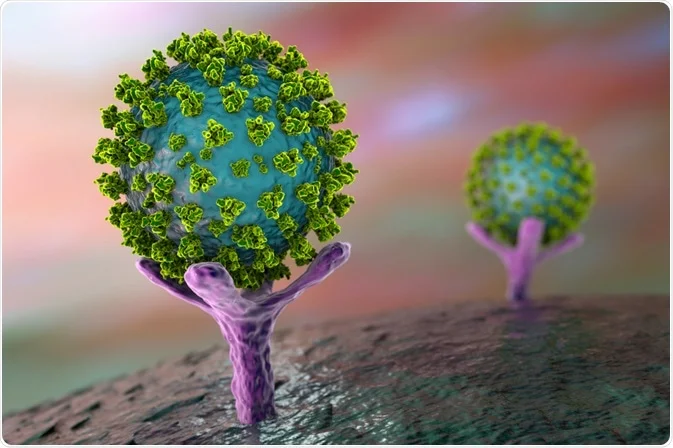
Image Credit: Kateryna Kon/Shutterstock.com
Size of SARS-CoV-2
Since the severe acute respiratory syndrome coronavirus 2 (SARS-CoV-2)
was first identified in December of 2019, many infectious disease
specialists, as well as researchers for almost every avenue of medicine,
have been investigating how this virus spreads to and infects human
beings, the wide range of severe health effects it can cause and
ultimately what drugs will be able to effectively kill this virus
safely.
In addition to mechanistic information, researchers have also
evaluated the size and content characteristics of the SARS-CoV-2
particles. Upon analysis of negative-stained SARS-CoV-2 articles by
electron microscopy, researchers have determined the diameter of this
virus to range between 60 nanometers (nm) to a maximum diameter of 140
nanometers (nm).
In addition to measuring the spherical size of the virus particle, it
has also been confirmed that the length of the size tumors that
surround the outermost surface of SARS-CoV-2 can vary in length from 9
to 12 nm.
Why does size matter?
Around the world, health officials have agreed that wearing masks can
prevent the spread of the virus between individuals. While this may be
true, certain masks are considered to be much more effective at
minimizing the risk of exposure, particularly N95 masks.
The protective capabilities offered by N95 masks are largely
attributed to the masks’ removal of more than 95% of all particles with
an average diameter that is 300 nm or less.
In fact, it has been estimated that N95 masks can filter
approximately 99.8% of particles that have an average diameter of 100
nm. In this aspect, the size of a virus particle largely determines how
individuals can protect themselves and those around them from acquiring
SARS-CoV-2.
Knowing the size of a single virus particle can also allow
researchers and healthcare providers to infer the amount of virus that
individuals are exposed to through different routes.
For example, respiratory droplets are typically 5-10 micrometers (µm)
in length; therefore, it can be inferred that an individual who
ingests, inhales, or is otherwise exposed to SARS-CoV-2 positive
respiratory droplets can be exposed to hundreds or thousands of virus
particles which increases the probability of infection.
Respiratory
droplets can be transmitted through coughing, sneezing, contact with
contaminated surfaces, or even through inhaled aerosols; therefore, each
individual must take adequate steps to reduce their exposure to these
particles by wearing masks and practicing safe social distance measures.
How does it compare to other viruses?
To date, research has shown that the viruses that have been
identified and isolated can range in diameter size from 20 nm to as
large as 500 nm. Aside from spherical virus particles like SARS-CoV-2
whose diameters provide information on their sizes, the length of rod-
or filament-shaped viruses can measure to as long as 1,000 nm.
Comparatively, the largest and most complex virus currently known to man
is the
Viruses, particularly those that originate from animals like
SARS-CoV-2 can differ greatly in their size. The smallest known animal
viruses are icosahedrons, which belong to the Paroviridae and
Picornaviridae families and can have a diameter ranging between 20 and
30 nm.
Comparatively, the largest and most complex virus currently known to
man is the giant Mimivirus, which has a total particle diameter, of
which includes the fibers that extend out from the capsid, of
approximately 750 nm.
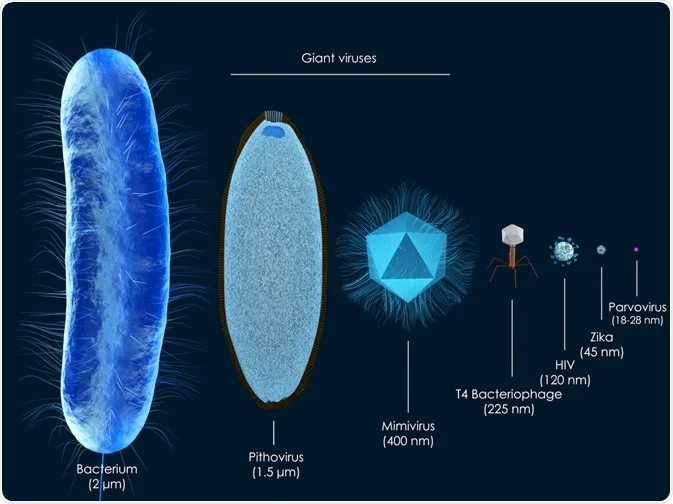
Image Credit: Meletios Verras/Shutterstock.com
Comparing bacteria and SARS-CoV-2 sizes
The SARS-CoV-2 virus is a much smaller particle when compared to the
primary models for bacterial cell biology, of which included Bacillus subtitles, Staphylococcus aureus, Escherichia Coli and Caulobacter crescentus, all of which have a cell volume that ranges from 400 nm to as large as 3 µm.
The large size of such bacterial species often contribute to their
diverse reproductive strategies and ultimately maximize their ability to
produce and release large offspring.
Everything else
Aside from the usefulness, that size comparisons between viruses and
bacteria can provide to researchers, it is also useful to compare the
size of SARS-CoV-2 to other objects that are encountered daily.
An ant, for example, has an average size of 5 millimeters (mm),
whereas a dust mite is typically 200 µm in size; both of which are much
larger than a single SARS-CoV-2 particle.
Comparatively, a human hair has a thickness that is typically in the
size range of 60 to 120 µm; while this diameter exceeds that of a
typical SARS-CoV-2 virus particle, one can imagine that the size of a
single human hair is comparable to the size of as little as 400
SARS-CoV-2 particles to as many as 1,000 particles.
References and Further Reading
- Bar-On, Y. M., Flamholz, A., Phillips, R., & Milo, R. (2020). SARS-Cov-2 (COVID-19) by the numbers. eLife 9. doi:10.7554/eLife.57309.
- “Modes of transmission of virus causing COVID-19: implications for IPC precaution recommendations. Scientific brief” – World Health Organization
- “Size and shape” – Britannia
- Wes Ser, D. R. (2010). Discovery of the Giant Mimivirus. Scitabe.
- Levin, P. .A., & Angert, E R. (2015). Small but Mighty: Cell Size and Bacteria. Cold Spring Harbor Perspectives in Biology 7(7). doi:10.1101/cshperspect.a019216.
Further Reading
